Hi! I am a postdoctoral researcher in the Department of Computer Science and the Data Science Institute at the University of Chicago, where I work closely with Mina Lee and Alex Kale.

I aim to develop technologies that support wellbeing for everyone while honoring people’s agency. I study people’s everyday lives through longitudinal, multimodal data, develop behavioral models to understand wellbeing patterns and improve their generalizability and fairness, and design AI-enabled systems that provide meaningful support for people with diverse needs. My work combines methods and theory from human-computer interaction, human-centered AI, ubiquitous computing, and social science.

I’m on the job market for 2026⁠–⁠2027. If you see a good fit, please don’t hesitate to reach out!

I received my Ph.D. from the Paul G. Allen School of Computer Science & Engineering at the University of Washington, where I was advised by Jennifer Mankoff and Anind K. Dey. I also interned with the Sensing Technology Group at Apple AIML. Before moving into human-centered computing, I studied coding theory and analytic number theory.

Research

“What matters is not living, but living well.”

— Socrates, in Plato’s Crito 48b

How to live well is one of humanity’s oldest questions. Today, technologies such as phones and wearables, machine learning models, and interactive AI systems can capture, understand, and support human wellbeing at scale, and increasingly inform who needs support and when. Yet (1) data need to reflect people’s lives over time, across diverse populations, and from multiple sources, (2) models need to be judged not only by accuracy but also by whether they are reliable and fair, and (3) systems need to return what they learn to people in an accessible form. Taking an end-to-end approach, my research addresses each of these needs, stage by stage:

1 Capture lived experience longitudinaldiversemultimodal

2 Understand people reliably and fairly early predictiongeneralizabilityfairness

3 Design meaningful support peer data explorationASL system

Data and people: captures life as it changes; people shape what is measured.

Model and people: stays reliable; people check what it infers.

System and people: sustains support; people steer what it offers.

People are at the center of my research, inside a loop of three stages (data, model and system), each linked to people in both directions.

Years of building datasets, models, and systems with people have taught me that lives change, models can misread daily life in ways people notice right away, and living well takes sustained support. These lessons point to a two-way loop between people and technology. In this loop, people shape what is measured, check what models infer, and steer the support they receive. Technologies, in turn, need measures that keep up with people’s lives, models that are both reliable and useful in practice, and systems that improve with use and keep supporting people over the long run. Neither side works alone. This is the wellbeing technology I am working toward, shaped by people and responsive to their lives over time.

Selected Publications

For a full list, see my CV or Google Scholar page.

1 Capture lived experience Data

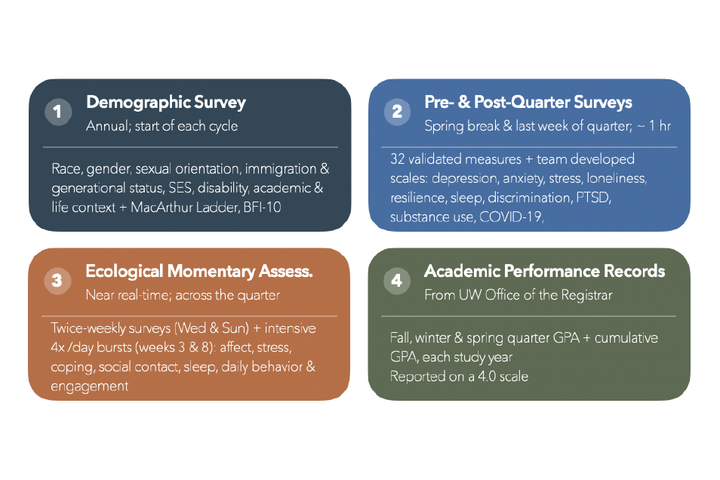
A Six-year Longitudinal Dataset of College Student Well-being, Daily Experience, and Academic Performance

In preparation

Han Zhang, Yasaman S. Sefidgar, Xuhai Xu, Yiyi Ren, Kevin S. Kuehn, Woosuk Seo, Paula S. Nurius, Margaret E. Morris, Eve A. Riskin, Anind K. Dey, Jennifer Mankoff

In preparation for Scientific Data.

GLOBEM Dataset: Multi-Year Datasets for Longitudinal Human Behavior Modeling Generalization

NeurIPS 2022

Xuhai Xu, Han Zhang, Yasaman S. Sefidgar, Yiyi Ren, Xin Liu, Woosuk Seo, Jennifer Brown, Kevin S. Kuehn, Mike Merrill, Paula S. Nurius, Shwetak Patel, Tim Althoff, Margaret E. Morris, Eve A. Riskin, Jennifer Mankoff, Anind K. Dey

Conference on Neural Information Processing Systems, Datasets & Benchmarks Track, 2022.

2 Understand people reliably and fairly Model

Sources of Inequity and Fairness Risks in Wellbeing Sensing

AIES 2026

Han Zhang, Vedant Das Swain, Koustuv Saha, Anind K. Dey, Jennifer Mankoff

AAAI/ACM Conference on AI, Ethics, and Society, 2026.

Towards Human-Centered Early Prediction Models for Academic Performance in Real-World Contexts

CSCW 2025

Han Zhang, Yiyi Ren, Paula S. Nurius, Jennifer Mankoff, Anind K. Dey

ACM Conference on Computer-Supported Cooperative Work and Social Computing, 2025.

GLOBEM: Cross-Dataset Generalization of Longitudinal Human Behavior Modeling

IMWUT 2023 Distinguished Paper Award

Xuhai Xu, Xin Liu, Han Zhang, Weichen Wang, Subigya Nepal, Yasaman S. Sefidgar, Woosuk Seo, Kevin S. Kuehn, Jeremy F. Huckins, Margaret E. Morris, Paula S. Nurius, Eve A. Riskin, Shwetak Patel, Tim Althoff, Andrew T. Campbell, Anind K. Dey, Jennifer Mankoff

Proceedings of the ACM on Interactive, Mobile, Wearable and Ubiquitous Technologies, 2023.

3 Design meaningful support System

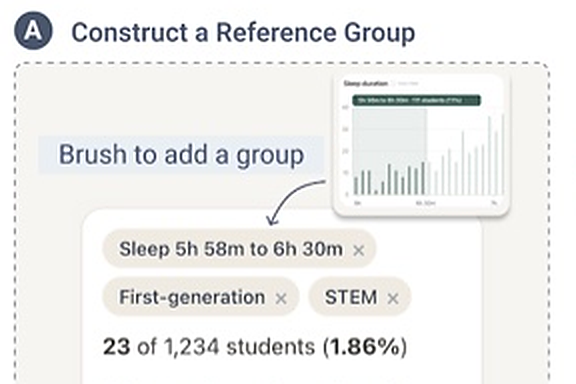
SEEN: A Student-Directed System for Multipurpose Exploration of Longitudinal Peer Data

Under review

Han Zhang, Dong Whi Yoo, Alex Kale, Mina Lee

Under review.

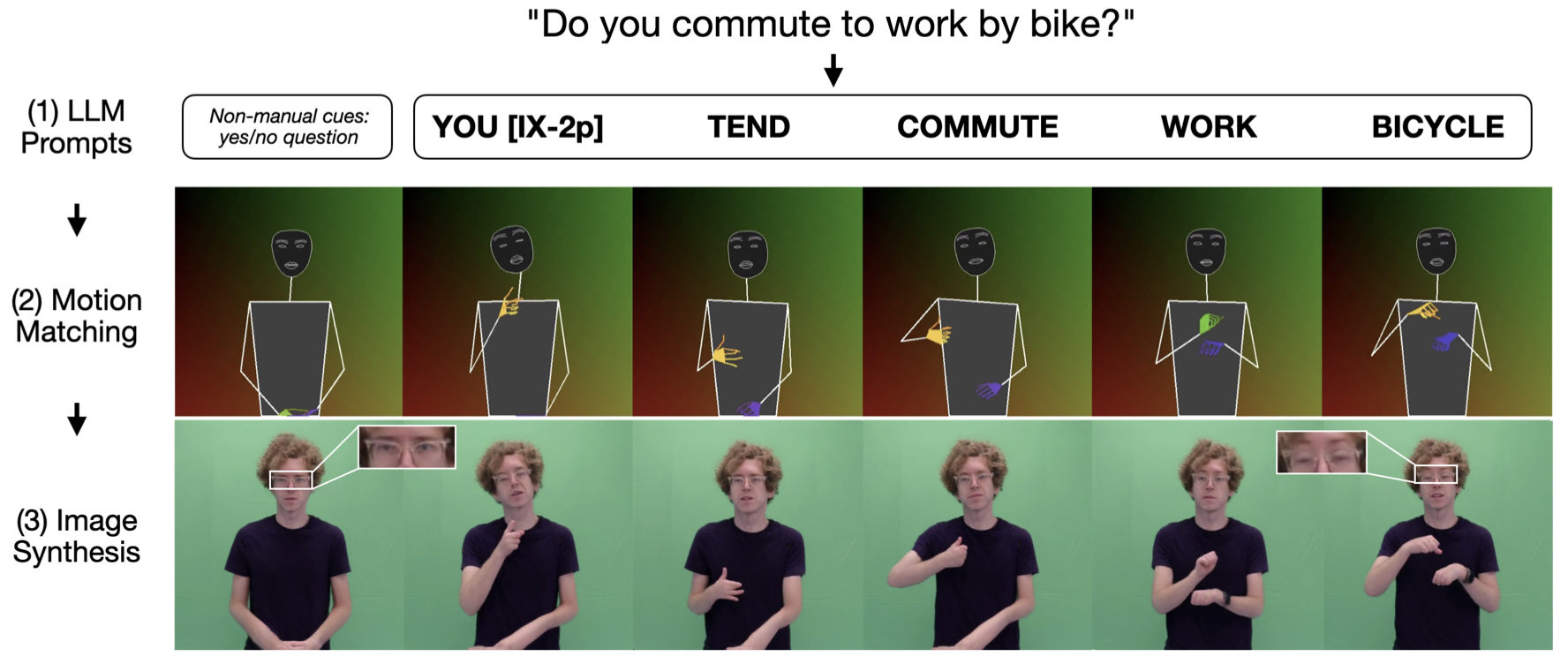
Towards AI-driven Sign Language Generation with Non-manual Markers

CHI 2025 Best Paper Honorable Mention

Han Zhang, Rotem Shalev-Arkushin, Vasileios Baltatzis, Connor Gillis, Gierad Laput, Raja Kushalnagar, Lorna Quandt, Leah Findlater, Abdelkareem Bedri, Colin Lea

ACM Conference on Human Factors in Computing Systems, 2025.